
Medicare Part D Notices Are Due By October 15
The date for distributing Medicare Part D notices is approaching.
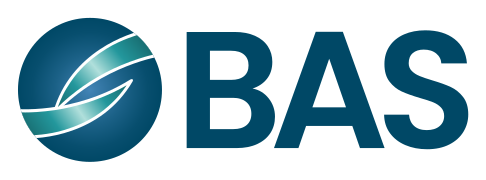
Take a close look at Line 14 of Form 1095-C to confirm coverage offers are reported correctly and consistently.

As the deadline for furnishing Form 1095-C approaches, HR professionals are once again preparing for one of the most detail-oriented aspects of Affordable Care Act (ACA) reporting. Before forms are distributed to employees, a careful review of each Form 1095-C is an important step to help ensure accuracy and avoid unnecessary follow-up or penalties.
Form 1095-C serves as the primary record of an employer’s health coverage offers to full-time employees. The IRS uses this form to assess employer compliance with the ACA’s employer shared responsibility provisions.
Before furnishing forms, HR teams should review each Form 1095-C for:
Catching errors at this stage can prevent corrected forms later and reduce employee confusion during tax season.
Accuracy in ACA reporting is especially important this year because the IRS no longer accepts a general good-faith compliance argument to relieve penalties. In prior years, employers that made reasonable efforts to comply could sometimes avoid penalties even if minor errors were present. That relief is no longer available.
Incorrect or inconsistent reporting can lead to:
For HR professionals, this means that careful attention to detail is no longer just a best practice. It is a necessity.
Line 14 is where employers report the type of health coverage, if any, that was offered to each employee for each month of the year. This line tells the IRS whether an offer of minimum essential coverage was made and to whom the coverage was offered.
To identify the correct Line 14 code, employers must understand:
Because Line 14 drives how the IRS evaluates compliance, accurate coding is especially important in the absence of good-faith compliance relief.
Below is a summary of commonly used Line 14 codes and what they represent:
Understanding these distinctions is key to selecting the correct code for each employee and each month.
When reviewing Line 14, HR professionals should:
Even small inconsistencies can raise questions during an IRS review.
Employers that use BAS for ACA Data Collection and Reporting can take comfort in knowing that Line 14 is coded automatically based on the data collected. This reduces the risk of manual coding errors and helps ensure consistent application of ACA rules.
For more information about BAS’s ACA Data Collection and Reporting Service, contact your account manager or email solutions@basusa.com.
Benefit Allocation Systems (BAS) provides online solutions for: Employee Benefits Enrollment; COBRA; Flexible Spending Accounts (FSAs); Health Reimbursement Accounts (HRAs); Leave of Absence Premium Billing (LOA); Affordable Care Act Record Keeping, Compliance & IRS Reporting (ACA); Group Insurance Premium Billing; Property & Casualty Premium Billing; and Payroll Integration.
MyEnroll360 integrates with major insurance carriers for enrollment eligibility management (e.g., Blue Cross, Blue Shield, Aetna, United Health Care, Kaiser, CIGNA and others), and with leading payroll platforms for enrollment deduction management (e.g., Workday, ADP, Paylocity, PayCor, UKG, and others).
This article is for informational purposes only and is not intended as legal, tax, or benefits advice. Readers should not rely on this information for taking (or not taking) any action relating to employment, compliance, or benefits. Always consult with a qualified professional before making decisions based on this content.
The date for distributing Medicare Part D notices is approaching.
For employers with multiple related companies, understanding how the ACA treats employees who move between entities is important for accurate eligibility and reporting.

Employers should avoid making eligibility decisions based solely on the employee's relationship to the individual.